



Important note. We are not doctors. We are not healers. We are not certified practitioners. We do not say our candles heal anything, we do not prescribe them, and we do not promise any outcome. We only make candles. Everything below about the root chakra, crystals and scent comes from tradition, published research and mineralogy, and it is cited so you can check it yourself. None of it is medical or financial advice. A candle will not treat anxiety, cure an illness or fix your finances. If you are dealing with a health concern, please speak to a qualified doctor. What a candle can offer is a calm, sensory ritual and a reason to sit still for ten minutes. The rest is yours.
You moved cities for the job. The flat is fine, the commute is not, and something about the whole arrangement still feels temporary two years in. That feeling has a name in yogic tradition, and root chakra candles in India have become one of the more popular ways people try to sit with it. Muladhara is the first of the seven chakras, the one concerned with safety, belonging and the ground under your feet.
What is the root chakra? In yogic tradition, the root chakra, or Muladhara, is the first of seven energy centres, placed at the base of the spine. Its Sanskrit name combines mula, meaning root, with adhara, meaning support or base [1]. It is associated with the earth element, the colour red, and a person’s basic sense of safety and stability. These are traditional teachings, not medical facts.
Now the longer version, including the parts most sellers leave out.
What Is the Root Chakra? (Muladhara)
Muladhara sits at the base of the spine. Most classical accounts place it at the perineum, though some traditions put it slightly higher, at the coccyx. Its element is earth, its traditional colour is red, its seed sound is LAM, and the deity associated with it in classical tantra is Ganesha, the remover of obstacles [2].
The symbol is a four-petalled lotus, usually drawn in red, with a yellow square at its centre representing Prithvi tattva, the earth element, and a downward-pointing triangle inside that [3].
This is not a recent idea dressed up in Sanskrit. The chakra system comes out of the tantric yogic traditions of India and is described in texts dating from at least the tenth century CE [2]. Classical sources including the Sat-Chakra-Nirupana treat Muladhara as the resting place of kundalini, the primal energy pictured as a coiled serpent [4]. Most traditional chakra work begins here rather than at the top, on the reasoning that the higher centres are unsteady without a settled foundation [2].
What a settled root is described as feeling like
Tradition associates a balanced Muladhara with feeling physically safe, financially steady, at home in your body, and able to trust that your basic needs will be met. You make decisions from a calm place rather than a defensive one.
What an unsettled root is described as feeling like
Restlessness. Money worry that does not switch off. Feeling untethered, like you are floating a foot above your own life. Difficulty settling anywhere.
This is where the tradition meets a fairly well-documented modern reality. A 2025 qualitative study of adults in Bangalore identified five urban factors that people consistently reported as pulling their mental health down: housing problems, traffic and transport, the character of the neighbourhood, cost of living, and work-related stress [5]. That is a reasonable description of a lot of metro Indian life.
The picture for people who have moved is sharper still. A survey of 400 educated migrant youth aged 21 to 35 living in Kolkata found that 61.8 percent showed symptoms of anxiety, 54.4 percent of depression and 47.9 percent of stress on the DASS-21 scale, with people who had migrated more than once at higher risk [6].
Read that alongside the traditional description of a blocked root chakra and the overlap is hard to miss. That is not proof that chakras exist. It is a reasonable explanation for why this particular chakra is the one people in Indian cities keep searching for.
How to Balance the Root Chakra: Three Steps
Traditional practice for the root chakra comes down to three things, and none of them require buying anything.
- Get physically low and still. Sit on the floor rather than a chair, ideally barefoot, for ten minutes a day. The root chakra is associated with the part of you that touches the ground.
- Slow the breath down deliberately. Four counts in, four held, four out. Five rounds. Traditional practice pairs this with the seed sound LAM, chanted aloud or silently.
- Attend to the actual foundation. Sleep, meals at regular hours, money you can account for, a home that feels like yours. Tradition treats the root chakra as the chakra of practical things, so practical fixes are the point rather than a distraction from it.
A candle, a stone or an affirmation can support that. None of them replaces it.
Which Crystals Are Used for the Root Chakra?
Crystal practice associates the root chakra with red, black and brown stones. Four come up repeatedly.
Black tourmaline
This is the stone in EKAA’s root chakra candle, and it is the one crystal practice most consistently ties to grounding and protection. It is associated with the lower chakras and is described in that tradition as steadying a person’s energy and creating a sense of security [7].
The mineral itself is called schorl. It is a borosilicate, its deep black colour comes from a high iron content, and it forms mainly in granite pegmatites. Commercially significant deposits sit in Brazil, several African countries, the United States and Afghanistan [8].
India does have black tourmaline. Documented occurrences include the Ajmer and Bhilwara districts of Rajasthan, associated with Aravalli pegmatites, and the Malkangiri area of Odisha. These are small, artisanal-scale deposits rather than commercial ones, and most black tourmaline in the Indian market arrives imported, largely through Mumbai, with cutting and processing concentrated in Jaipur [9]. Worth knowing if a seller tells you their stones came out of Indian soil.
Red jasper
An opaque, brick-red quartz coloured by iron oxide. Its red matches the root chakra’s traditional colour, and practice associates it with stamina, courage and steady endurance rather than protection. It is the stone usually suggested for people rebuilding after a long, depleting stretch [10].
Hematite
Iron oxide, and the most important ore of iron. It is noticeably heavy for its size and leaves a reddish streak, which is where its name comes from, via the Greek word for blood [11]. That density is exactly why tradition treats it as the most physically grounding of the group.
Smoky quartz
Brown to grey translucent quartz. Practice frames it as the gentle one, associated with releasing what has built up rather than shielding against what is coming in [12].
Where the evidence actually sits
There is no peer-reviewed evidence that crystals produce any effect beyond placebo. The best-known test of this was run by researchers French and Williams, who found that participants could not distinguish real quartz from glass imitations, and concluded there was no evidence crystal healing works above a placebo effect [13].
We would rather say that plainly than sell you something we cannot back. It does not make the ritual pointless. If lighting a candle and sitting still with a stone in your hand makes you calmer, the calm is real, and it is coming from you and from the ten minutes you gave yourself. That is a more durable place for it to come from than a rock.
Root Chakra Fragrances: What Grounding Actually Smells Like
Frankincense, the oil in EKAA’s root chakra candle
Frankincense is resinous, warm and slightly dry, closer to woodsmoke than to anything floral. It has been burned in ritual across the subcontinent and West Asia for centuries.
On the research: a small study reported that people who inhaled frankincense essential oil rated their anxiety lower and their mood better than a placebo group. Systematic reviews, however, generally conclude that the evidence for aromatherapy in anxiety is either insufficient or limited by the quality of the available studies [14]. So the honest summary is that it smells grounding to a lot of people and the science is early and thin. We are not going to overstate it.
Ginger and sage, the herbs in the blend
Ginger is one of the most used single herbs in Ayurveda, referred to in the tradition as vishwabhesaj, the universal medicine [15]. It is classified as pungent with a heating effect, which is why the tradition treats it as balancing for vata and kapha, both of which are cool in nature [16]. In a root chakra context, a warming, earth-grown rhizome is a sensible pairing. It grows down, not up.
Sage brings a dry, herbal note that cuts the sweetness of the resin. Together with the ginger, it keeps the blend from going too warm and syrupy.
Inside EKAA’s Root Chakra Candle
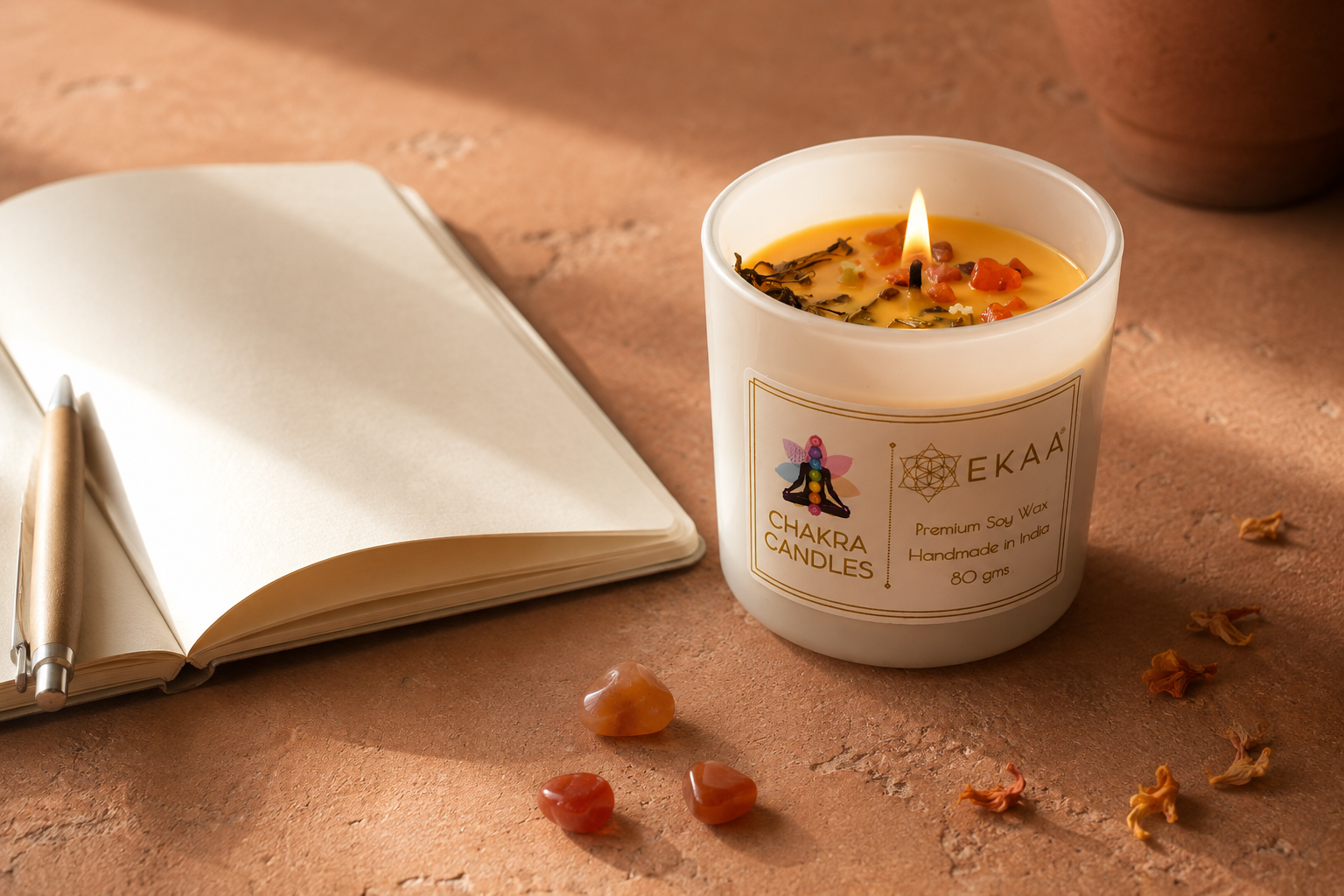
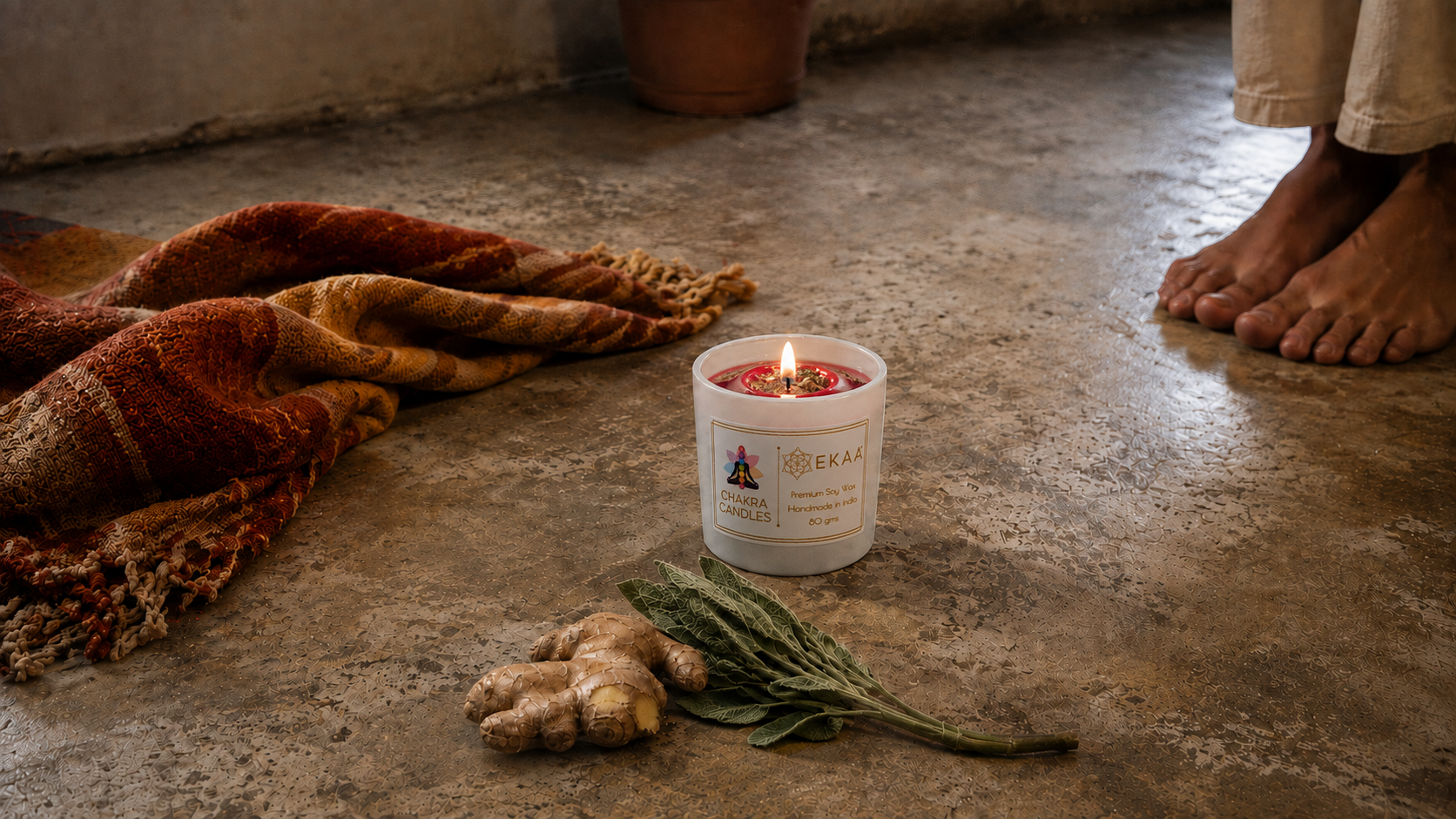
The मूलाधार (Muladhara) Root Chakra Candle is hand-poured vegan soy wax in deep red, in a white glass jar. Inside it: frankincense essential oil, black tourmaline chips, and ginger and sage.
Everything about it is deliberate. Red for the chakra’s traditional colour. Black tourmaline as the stone practice associates most strongly with grounding. Frankincense as the resin that has been burned in ritual longer than almost anything else. Ginger and sage as two herbs that grow in and close to the earth.
What it is not: a treatment. It is a candle with a considered blend and a stone in it, made in small batches in Mumbai, poured to order. What it does is give you a reason to sit down.
Current sizes, burn times and pricing are on the product listing below.

Complete Chakra Candles Set by EKAA™ Candles – Align & Activate All Seven Chakras
Original price was: ₹3,675.₹2,999Current price is: ₹2,999. (18% OFF)
मूलाधार (Mooladhar) – Root Chakra Candle | Chakra Meditation Soy Wax Candle with Frankincense and Black Tourmaline
Original price was: ₹500.₹400Current price is: ₹400. (20% OFF)An Evening Grounding Ritual You Will Actually Keep
Ten minutes. No equipment beyond the candle.
When. Evening, when the day’s noise has settled and the mind starts running. Before bed works. So does the moment you get home.
Set up. Sit on the floor, not on the sofa. Barefoot if you can manage it. Put the candle at floor level in front of you, roughly an arm’s length away, and away from curtains and anything that catches.
Light it. Give it a minute before you start. Let the scent fill the space first.
Hands. Rest them on your knees, palms facing down. The downward palms are the traditional gesture here, associated with earth rather than sky.
Breathe. Four counts in. Hold for four. Four counts out. Five rounds, slowly. If you lose count, start again without making it a problem.
Say it. I am safe. I am supported. I belong here. Out loud if you are alone, silently if you are not. Traditional practice pairs this with the seed sound LAM if you want to add it.
Sit. Another few minutes with the flame. No phone. No agenda.
Afterwards. When the candle is finished, tradition suggests keeping the stone somewhere it will be seen daily. The foot of the bed and near the front door are the two most commonly suggested places.
Once a day is more useful than once a week for an hour. The consistency is the whole thing.
Who a Root Chakra Candle Suits
- Anyone who has just moved. New city, new flat, new job. The unsettledness that comes with relocating is exactly what this chakra is described as governing.
- People in high-pressure work. If your week is meetings and deadlines and you cannot remember the last time you sat on the floor, this is a ten-minute correction.
- Anyone building a meditation or yoga practice. Traditional teaching starts at the root and works upward. This is the sensible entry point to the seven.
- As a griha pravesh or housewarming gift. A grounding candle for a new home is one of the few wellness gifts that actually means something in context.
Who it is not for: anyone hoping it will replace treatment for anxiety, sleep problems or anything else clinical. Please see a doctor for that. This is a candle.
Grounding and Earthing Are Not the Same Thing
These get used interchangeably online and they should not be.
Grounding, in the yogic and psychological sense, means practices that bring your attention back into your body and the present moment. Breathwork, sitting still, feeling your feet on the floor. This is what a candle ritual supports.
Earthing is a specific wellness claim: that direct skin contact with the earth’s surface transfers electrons into the body and produces measurable health effects. The Cleveland Clinic’s assessment is that while there is some evidence suggesting earthing may be good for you, these claims are not backed by high-quality research [20].
Walking barefoot on grass is pleasant, and there is nothing wrong with doing it. Just do not confuse a nice thing to do with a proven medical intervention. We are not going to sell you the second one.
More Chakra Reading from EKAA
If this is your first stop, the place to go next is our beginner’s guide to the seven chakras. It runs through all seven in order, covering what each one is called in Sanskrit, where tradition places it in the body, which element and colour it carries, and what a balanced and unbalanced state is described as feeling like. Read it if you want the full map before working through the individual guides.
Several of our crystal guides cover chakras above the root, so you can follow the system upward by stone rather than by chakra. Our citrine guide deals with Manipura, the solar plexus, which tradition connects to confidence and personal power. It also explains the difference between naturally occurring and heat-treated citrine, which is the single most useful thing to understand before buying anything citrine in India.
Our amethyst guide covers two chakras at once, Ajna at the third eye and Sahasrara at the crown, since amethyst is traditionally associated with both. It also digs into India’s own amethyst deposits in the Deccan Traps around Nashik and Aurangabad, which very few people realise exist.
Our clear quartz guide and our green aventurine guide are the other two crystal pieces worth reading alongside this series. Clear quartz sits with the crown chakra in most crystal practice, and green aventurine with Anahata, the heart.
The remaining six chakra guides are being published in order. Svadhishthana, the sacral chakra, is next, followed by Manipura, Anahata, Vishuddha, Ajna and finally Sahasrara. Each one follows the same structure as this post: what the tradition actually says, which stones and scents are associated with it, an honest account of the evidence, and a ritual you can keep.
If you would rather browse than read, the full Chakra Candles collection has all seven candles and the sets.
Where to Start
If you are new to the seven, start at the bottom. That is what the tradition itself recommends, and it is the least mystical advice in this entire post: get the foundation steady before you go looking for enlightenment.
Light it in the evening. Sit on the floor. Give it ten minutes.
Next in the series: Sacral Chakra Candles
FAQs about Root Chakra Candles
How do I know if my root chakra is blocked?
There is no test for this, and nobody can diagnose it. In yogic tradition, an unsettled Muladhara is described as chronic restlessness, persistent worry about money or security, feeling disconnected from your body, and difficulty feeling at home anywhere. That description overlaps heavily with ordinary anxiety, which is a medical matter. If these feelings are affecting your daily life, please speak to a doctor or a mental health professional rather than treating it as an energy problem.
What colour is the root chakra?
Red. In traditional iconography, Muladhara is drawn as a four-petalled red lotus with a yellow square at its centre representing the earth element. EKAA’s root chakra candle is poured in deep red for this reason.
Can a candle really help balance chakras?
No, and we are not going to claim otherwise. There is no scientific evidence that candles, crystals or scent affect chakras, and no evidence that chakras exist as physical structures. What a candle does is create a signal and a setting: a specific scent, a flame to look at, and a reason to stop. If that helps you sit still for ten minutes when you otherwise would not, the benefit is real, and it comes from the sitting still.
Which crystal is best for grounding?
Crystal practice most commonly names black tourmaline for grounding and protection, red jasper for stamina, hematite for physical steadiness, and smoky quartz for release. Black tourmaline is the one in EKAA’s root chakra candle. None of these have been shown to have any effect beyond placebo in controlled testing.
How often should I do a root chakra ritual?
Daily and short beats occasional and long. Ten minutes each evening is more sustainable than an hour once a week, and consistency is what makes any ritual stick. Start with three evenings a week if daily feels like too much.
What is the difference between grounding and earthing?
Grounding refers to practices that bring your attention back into your body and the present moment, such as breathwork or sitting still. Earthing is a separate and specific claim that direct skin contact with the ground transfers electrons and produces health benefits. The Cleveland Clinic notes that earthing claims are not supported by high-quality research. Walking barefoot on grass is enjoyable, but it is not a proven medical intervention.
References
- Fitsri Yoga. What is Root Chakra? Symbol, Location, and Its Signs of Balanced and Imbalanced. https://www.fitsri.com/articles/root-chakra-muladhara
- JobCannon. Root Chakra (Muladhara): Foundation, Stability, and Survival. https://jobcannon.io/blog/root-chakra-meaning
- Siddhi Yoga. Root Chakra: Meaning, Symbol, Colour and Muladhara Balance. https://www.siddhiyoga.com/yoga/practice/chakras/root-chakra
- Spiritual Marker. Root Chakra Meaning: Complete Guide to the Muladhara Chakra. https://www.spiritualmarker.com/root-chakra-meaning-complete-guide-to-the-muladhara-chakra/
- Poddar et al. How city living affects mental health: a qualitative exploration of urban stressors among adults in a megacity in India. BMC Public Health, 2025. https://link.springer.com/article/10.1186/s12889-025-22817-x
- Psychological implications of unemployment among higher educated migrant youth in Kolkata City, India. PMC. https://pmc.ncbi.nlm.nih.gov/articles/PMC11068866/
- Energy Muse. Black Tourmaline Meaning and Healing Properties. https://energymuse.com/pages/blacktourmaline-meaning
- Crystalline Dream. The Meaning of Black Tourmaline: A Stone of Protection and Grounding. https://www.crystallinedream.com/blogs/crystals-and-consciousness/the-meaning-of-black-tourmaline-a-stone-of-protection-and-grounding
- Ratna Gems. Black Tourmaline Guide: Price, Benefits, Identification and Vastu Tips. https://ratnagems.com/black-tourmaline-complete-guide/
- Crystals.com. Best Crystals for Root Chakra. https://www.crystals.com/blogs/news/best-crystals-to-balance-root-chakra
- Solacely. Hematite and Red Jasper: Grounding Stones for Stability. https://www.solacely.co/en-us/blogs/crystals/hematite-and-red-jasper
- Centre of Excellence. 9 Essential Root Chakra Crystals for Grounding and Stability. https://www.centreofexcellence.com/crystals-for-root-chakra/
- ZME Science. The power of “healing” crystals: what they can and can’t do. https://www.zmescience.com/feature-post/natural-sciences/geology-and-paleontology/rocks-and-minerals/healing-crystals-pseudoscience/
- Using Frankincense for Mood and Stress: Science, Uses and Safety Guide. https://menstreaze.com/article/using-frankincense-for-mood-stress-science-uses-safety-guide
- Banyan Botanicals. Ginger: Getting to Know Your Herbal Allies. https://www.banyanbotanicals.com/blogs/wellness/getting-to-know-your-herbal-allies-ginger
- Starwest Botanicals. Ginger for Full Body Wellness. https://www.starwest-botanicals.com/blog/ginger-for-full-body-wellness-starwest-botanicals/
- The Love Co. Vetiver Fragrance India: The Root Behind India’s Best Attars. https://theloveco.in/blogs/the-journal/vetiver-fragrance-india
- Laxmi Ayurvedic Store. Vetiver (Khus): The Cooling, Calming and Grounding Herb. https://www.aryuvedicstore.com/blogs/post/vetiver-khus-the-cooling-calming-grounding-herb
- Science India Magazine. Sandalwood: A Timeless Healer for Body, Mind and Spirit. https://scienceindiamag.in/a-timeless-healer-for-body-mind-and-spirit/
- Cleveland Clinic. Is Earthing Actually Good for You? Here’s What We Know. https://health.clevelandclinic.org/earthing