


Important note. We are not doctors. We are not healers. We are not certified practitioners. We do not say our candles heal anything, we do not prescribe them, and we do not promise any outcome. We only make candles. Everything below about the root chakra, crystals and scent comes from tradition, published research and mineralogy, and it is cited so you can check it yourself. None of it is medical or financial advice. A candle will not treat anxiety, cure an illness or fix your finances. If you are dealing with a health concern, please speak to a qualified doctor. What a candle can offer is a calm, sensory ritual and a reason to sit still for ten minutes. The rest is yours.
If your creativity has gone quiet, if you feel emotionally flat or all over the place, or if joy just feels harder to reach than it used to, the sacral chakra is the part of the yogic map that speaks to all of that. Sacral chakra candles in India have become a gentle, popular way to sit with that idea for a few minutes a day. This guide explains what the sacral chakra is, the orange stone that tradition pairs with it, and how to actually use a candle without believing anything you do not want to believe.
What are sacral chakra candles used for? They are candles made as a focus for the sacral chakra, or Svadhisthana, the energy centre linked in yoga to creativity, emotion, pleasure and relationships. People light them during creative work, journaling or meditation to set an intention and slow down. They are a ritual tool, not a treatment.
What Is the Sacral Chakra? (Svadhisthana)
Svadhisthana is the second of the seven main chakras. The name is usually read as “one’s own dwelling place,” and in yoga it is the centre tied to creativity, desire and emotional flow [1]. You will find it placed in the lower abdomen, a few finger-widths below the navel, near the pelvis [1].
A few plain markers make it easy to remember. Its element is water, which is why people talk about it in terms of flow, softness and movement. Its colour is orange. Its symbol is a six-petalled lotus [1]. Where the root chakra is about feeling safe and grounded, the sacral chakra sits one step up and asks a different question: are you able to feel, create, enjoy and connect?
In this tradition, a balanced sacral chakra shows up as creativity that comes easily, emotions that move through you without running the show, and comfort with pleasure and closeness [1]. When people describe it as blocked, they talk about creative dryness, feeling emotionally numb or swinging between extremes, guilt around pleasure, and tension in the hips and lower back [1]. If any of that sounds familiar, you are in the right place. None of it is a diagnosis. It is a language for paying attention to yourself.
If you have not read it yet, the sacral chakra sits directly above the root, so it helps to start there. Our root chakra candles guide [https://www.ekaacandles.com/root-chakra-candles-india-guide/] covers the ground-floor chakra this one builds on.
Carnelian: The Orange Stone of the Sacral Chakra
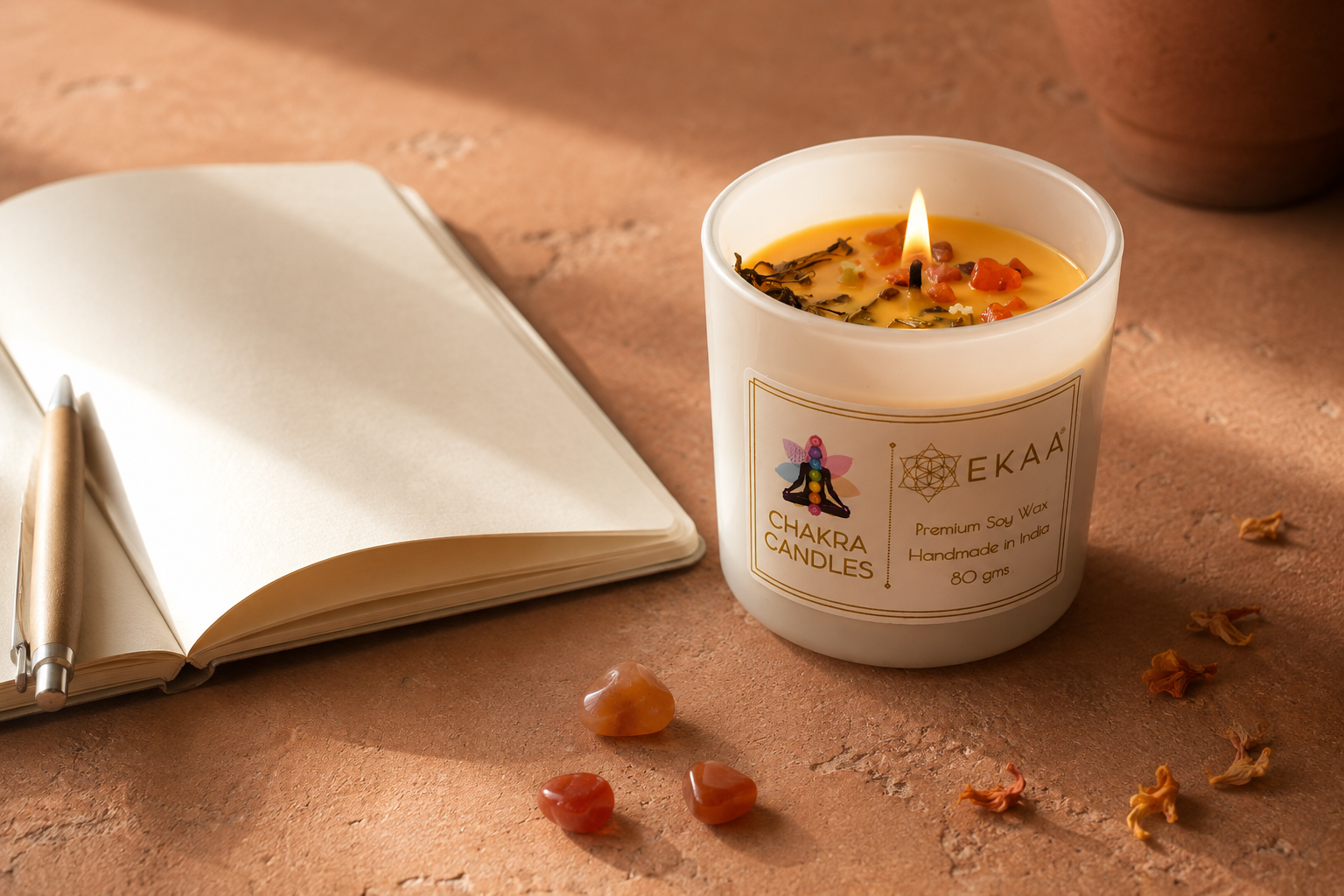
Every chakra in crystal practice has stones that people pair with it, and for the sacral chakra the classic choice is carnelian. It is the warm orange stone you will see in most sacral candles, EKAA’s included.
Here is what carnelian actually is, no mystery required. Carnelian is a variety of chalcedony, which is a very fine-grained form of quartz. Its orange-to-red colour comes from iron oxide inside the stone [2]. So it is a quartz cousin of the amethyst and clear quartz you may already know, just coloured by iron rather than left clear.
And it has an Indian story that is easy to be proud of. The town of Khambhat, once called Cambay, in Gujarat has been cutting carnelian and agate for roughly four thousand years [2]. Carnelian beads and bead-making workshops at the Indus city of Lothal date to at least 2500 BCE, and beads from this region travelled as far as Mesopotamia [2]. When you hold a piece of carnelian in India, you are holding a stone your ancestors were shaping and trading before most of recorded history.
In crystal tradition, carnelian is the stone people reach for around the sacral chakra because it is linked with creativity, motivation, confidence and the push to move from thinking about something to actually doing it [3]. EKAA’s own note on the stone calls it one of motivation, vitality and courage. That is the tradition, and it is worth saying clearly what the tradition is not.
There is no scientific evidence that carnelian, or any crystal, produces a healing effect beyond the placebo response [4]. If a stone helps you feel more creative or more settled, the effect is real to you, but the evidence points to belief, ritual and the quiet pause doing the work, not a force leaving the stone. We would rather tell you that straight. It does not make the ritual pointless. It puts the value where it belongs, in you and in the habit.
Why Ylang Ylang Suits This Chakra
Scent is the fast lane to how you feel. It reaches the emotional part of the brain before you have had time to think, which is exactly why it belongs in an emotional, sacral-chakra candle.
EKAA’s sacral candle is scented with ylang ylang, a rich, sweet, slightly heady floral. It is a fitting match for a chakra about pleasure and emotion, and there is some research behind the calm people report from it. Small aromatherapy studies have linked ylang ylang to lower blood pressure and a calmer, more relaxed state, though the studies are small and the effect is gentle rather than dramatic [5]. We mention it because it is honest context, not because a scent will rearrange your feelings.
Other scents show up in the sacral tradition too, and they are worth knowing even though they are not in this particular candle. Sweet orange is the clearest example: in a randomised human trial, sweet orange aroma produced an acute, anxiety-reducing effect during a stressful task [6]. Rose and jasmine, both woven deep into Indian ceremony and daily life, are the other two scents people commonly tie to this warm, open, sensual chakra. If you are exploring, those are the notes to follow.
A Simple Creativity Ritual With Your Sacral Candle
You do not need to meditate well or believe anything specific for this to be useful. A short, deliberate ritual is something psychology takes seriously. In controlled experiments, doing a small, set ritual before a stressful task lowered people’s anxiety and even their heart rate, and it worked because they treated it as a ritual [7]. That is the real mechanism here. Use it before you create.
Step 1. Sit at your desk, table or wherever you make things. Keep a journal, sketchbook or laptop within reach.
Step 2. Hold the candle for a moment before lighting it. Say one small, honest intention. “I am letting myself make something imperfect today.” Keep it kind.
Step 3. Light the wick with your full attention. Then set a timer for ten minutes and make something without stopping to judge it. Freewrite, sketch, hum, move. No editing, no deleting.
Step 4. When the timer ends, keep the candle burning while you carry on if you are in flow. If you are done, retrieve the carnelian once the wax around it has melted enough to remove it safely, let it cool, rinse it, and keep it on your desk as a small reminder.
Safety note. Never leave a burning candle unattended. Keep it away from curtains, drafts, pets and children, and always place it on a heat-safe surface.
Who Is This Candle For?
A sacral chakra candle suits the person who used to paint, write, dance or make and quietly stopped. It suits anyone in a creative job staring at a blank page. It suits the person who has been so busy holding everything together that pleasure and play fell off the list. And it makes a thoughtful gift for the creative friend you want to see light back up.
Men are just as welcome here, for the record. Creativity and emotion are not gendered, and the ritual works the same for everyone. We cover that properly in our upcoming guide on crystal candles for men.
Which EKAA Candle to Choose
If you want to work with this chakra, EKAA’s sacral candle is the place to start, and there are two sets if you would rather build the whole practice at once. Here they are.

Complete Chakra Candles Set by EKAA™ Candles – Align & Activate All Seven Chakras
Original price was: ₹3,501.₹2,857Current price is: ₹2,857. (18% OFF)
Energy Restoring Chakra Candle Set by EKAA™ – For Balance, Stress Relief, and Renewal
Original price was: ₹1,501.₹1,357Current price is: ₹1,357. (10% OFF)
स्वाधिष्ठान (Svadhishthana) – Sacral Chakra Candle | Chakra Meditation Soy Wax Candle with Ylang Ylang and Carnelian Crystals
Original price was: ₹500.₹400Current price is: ₹400. (20% OFF)The Svadhishthana candle is a vibrant orange soy wax candle with carnelian, ylang ylang, and dried hibiscus and calendula petals. Carnelian leads on creativity and warmth, ylang ylang carries the mood. If you want more than one chakra, the Complete Chakra Candles Set brings all seven together, and the Energy Restoring Chakra Candle Set groups the sacral candle with the solar plexus and heart candles, the three that carry the lower and middle body. Either way, the sacral candle is a natural next step after the Root chakra candle, since the two lower chakras work as a pair, safety first, then feeling and flow.
A quick word on the wax. EKAA uses soy wax rather than paraffin. Soy is plant-based, renewable and tends to burn slower. The honest science says a well-made candle of any wax burns within safe air-quality limits, and that soot comes mostly from a poor wick or a bad burn rather than the wax name on the label [8]. We choose soy for the renewable, slower, cleaner-burning experience, not as a health claim.
Explore the range in the Meditation & Healing Collection.
More Chakra Reading from EKAA
If this is your first stop, the place to go next is our beginner’s guide to the seven chakras. It runs through all seven in order, covering what each one is called in Sanskrit, where tradition places it in the body, which element and colour it carries, and what a balanced and unbalanced state is described as feeling like. Read it if you want the full map before working through the individual guides.
Several of our crystal guides cover chakras above the root, so you can follow the system upward by stone rather than by chakra. Our citrine guide deals with Manipura, the solar plexus, which tradition connects to confidence and personal power. It also explains the difference between naturally occurring and heat-treated citrine, which is the single most useful thing to understand before buying anything citrine in India.
Our amethyst guide covers two chakras at once, Ajna at the third eye and Sahasrara at the crown, since amethyst is traditionally associated with both. It also digs into India’s own amethyst deposits in the Deccan Traps around Nashik and Aurangabad, which very few people realise exist.
Our clear quartz guide and our green aventurine guide are the other two crystal pieces worth reading alongside this series. Clear quartz sits with the crown chakra in most crystal practice, and green aventurine with Anahata, the heart.
If you would rather browse than read, the full Chakra Candles collection has all seven candles and the sets.
Where to Start
If you are new to the seven, start at the bottom. That is what the tradition itself recommends, and it is the least mystical advice in this entire post: get the foundation steady before you go looking for enlightenment.
Light it in the evening. Sit on the floor. Give it ten minutes.
FAQs about Sacral Chakra Candles
What are the signs of a blocked sacral chakra?
In yogic tradition, a blocked or imbalanced sacral chakra is described as creative dryness, emotional numbness or big emotional swings, guilt around pleasure, trouble with intimacy, and tension in the hips and lower back [1]. These are traditional descriptions for self-reflection, not medical symptoms. If something feels genuinely wrong, speak to a qualified professional.
Which crystal is best for creativity?
Crystal practice most often pairs carnelian with creativity and the sacral chakra, because it is linked with motivation, confidence and moving from idea to action [3]. This is tradition, not proven fact. There is no scientific evidence that any crystal heals beyond the placebo effect [4].
What colour represents the sacral chakra?
Orange. The sacral chakra, Svadhisthana, is tied to the colour orange, the element water, and a six-petalled lotus, and it sits just below the navel [1]. That is why sacral candles, EKAA’s included, are made in a warm orange.
Can men use sacral chakra candles?
Yes. Creativity, emotion and the sacral chakra are not gendered, and the ritual is the same for anyone. The candle is for any person who wants a few quiet minutes to reconnect with making and feeling.
How is the sacral chakra different from the root chakra?
The root chakra sits at the base of the spine and is about safety, stability and feeling grounded. The sacral chakra sits just above it, below the navel, and is about creativity, emotion, pleasure and connection [1]. In practice people often work with the root first, then the sacral.
How do I set an intention with a sacral chakra candle?
Hold it before lighting, say one small, honest intention out loud or silently, then light the wick with full attention and make something for ten minutes without judging it. The value is the ritual itself. Deliberate rituals have been shown to lower anxiety and heart rate before stressful moments [7].
A final honest note. Everything here is tradition, culture and cited research, shared so you can enjoy a beautiful ritual with clear eyes. EKAA makes vegan, hand-poured soy wax candles. We are not doctors or healers, we do not prescribe our candles, and we make no promises about health, creativity or outcomes. The ritual is yours to make meaningful.
References
- Arhanta Yoga, “Svadhishthana Chakra: All You Need to Know About the Sacral Chakra” (meaning, location, water element, orange colour, six petals, balanced and blocked signs). https://www.arhantayoga.org/blog/svadhishthana-chakra-all-you-need-to-know-about-the-sacral-chakra/
- SkyJems, “Cambay (Khambhat): Gujarat’s Ancient Centre of Carnelian and Agate” (carnelian as iron-oxide-coloured chalcedony/quartz; ~4,000 years of lapidary at Khambhat; carnelian bead workshops at Lothal from at least 2500 BCE; trade to Mesopotamia). https://skyjems.ca/pages/encyclopedia-cambay
- Crystals.com, “Carnelian Crystal: The Complete Guide to Meaning, Properties & History” (sacral chakra association; creativity, motivation, confidence in crystal tradition). https://www.crystals.com/blogs/news/carnelian-crystal-the-complete-guide-to-properties-history-styling
- Healthline, “Do Healing Crystals Work? Lore, History, Research” (evidence is largely anecdotal/placebo). https://www.healthline.com/health/healing-crystals-what-they-can-do-and-what-they-cant
- Hongratanaworakit T. & Buchbauer G., “Relaxing effect of ylang ylang oil on humans after transdermal absorption,” Phytotherapy Research, 2006 (ylang ylang linked to lower blood pressure and a calmer state). https://onlinelibrary.wiley.com/doi/abs/10.1002/ptr.1950
- Goes T.C. et al., “Effect of sweet orange aroma on experimental anxiety in humans,” randomised trial (acute anxiolytic effect), PubMed 22849536. https://pubmed.ncbi.nlm.nih.gov/22849536/
- Brooks A.W. et al., “Don’t Stop Believing: Rituals Improve Performance by Decreasing Anxiety,” Harvard Business School. https://www.hbs.edu/faculty/Pages/item.aspx?num=51401
- CandleScience, “Paraffin wax: how it’s made, why it’s controversial, and what the science says” (soy vs paraffin burn/soot). https://www.candlescience.com/paraffin-wax-how-it-s-made-why-it-s-controversial-and-what-the-science-says/
(Numbering follows order of first appearance in the body.)